

With this article, Tereny launches Zblyzka, a new media project dedicated to exploring the outstanding cultural phenomena and figures of Ukraine. As with our other initiatives, we begin with the Poltava region. Read and share our stories in Ukrainian and English to help more readers discover the roots and richness of Ukrainian culture.
1908. The Poltava region. On the highest hills — chosen so they could be seen from afar — unusual buildings began to rise, found only in the Poltava Governorate. They featured numerous hexagonal windows and intricate brick «embroidery» on their façades, each pattern unique. A tower crowned the structure, signaling that this was no ordinary building but a temple of learning. The ceilings were deliberately high, so that the children studying there would not feel confined, but free.
Worn down by time or damaged by human hands, many are quietly falling into ruin. Yet some are being brought back to life thanks to dedicated local communities.
So what makes Opanas Slastion’s schools unique for Poltava and for Ukraine as a whole?
The Emergence of Zemstvo Schools in the Poltava Region
In 1908, the Russian Empire introduced compulsory primary education and launched a large-scale school construction program. The plan allowed twenty years for its implementation, and thanks to sufficient funding, the Poltava Governorate became one of the first regions to begin building. These were not meant to be ordinary schools, but distinctive and architecturally ambitious buildings. Members of the Ukrainian intelligentsia insisted that they be designed in a national architectural style.
Naturally, the proposal met with resistance. Opponents even fabricated petitions allegedly signed by peasants, claiming they rejected anything «national.» But the attempt failed. The head of the Lokhvytsia Zemstvo Board, Mykola Tereshkevych— a retired colonel — firmly rejected these arguments and defended the need to build the schools in a national architectural style. In his speech, he stressed that the voice of the peasantry should always be heard — but only when it truly belongs to the peasantry, and not to those who speak on its behalf while using foreign words.
In the fall of 1910, construction of the first schools began in the villages of Mlynky and Holinka in the Lokhvytsia district. The task of designing them fell to Opanas Slastion, the region’s leading authority on folk architecture, whose vision would transform these schools into more than just classrooms.
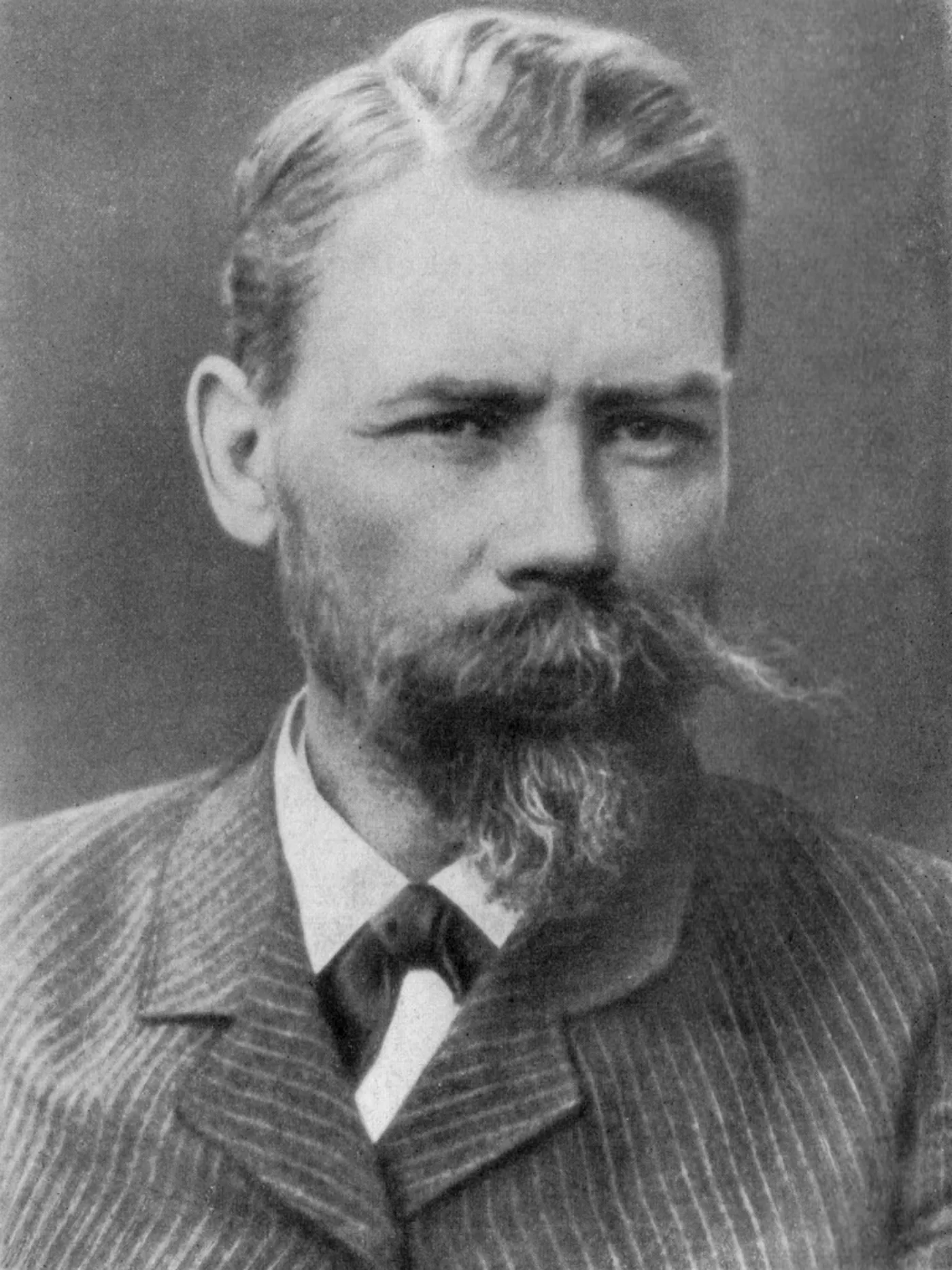
Opanas Slastion (1855—1933) was born in Berdiansk into a family of painters. Both his grandfather and father were artists, and he later received his professional training at the Academy of Arts in St. Petersburg. Yet Slastion believed Ukrainian art had to break free from endless imitation and borrowing. Instead, he argued, it should develop independently, because «there is no culture in the world that is built on the denial of the creative spirit of its people.»
In 1911, construction started on twenty-four schools across the Poltava region. Depending on local needs, some villages could have two institutions built from the same design. Within just a year, new school buildings appeared across the region in the towns of Varva (now in Chernihiv region), Horodyshche, and Kurinka; in villages such as Bezsaly, Bilotserkivka, Bondari, Hiltsi, Kizlivka, Lomaky, Mokiyivka, Svitlychne, Tokari, Shmyhli, and Yaroshivka; and in smaller hamlets including Herasymivka, Zalatyha, Syniakivshchyna, and Yakontove.
Between 1912 and 1917, more than ninety schools were built across the province. Construction, however, was expensive, and the original designs were gradually simplified. Plans for village libraries and caretakers’ rooms were dropped, while teachers’ rooms, classrooms, and cloakrooms were made smaller. Yet one principle remained unchanged: the required air volume per pupil.
Building these schools required significant investment. A single-class school cost about 6,400 karbovanets, which was worth around thirty years’ worth of a worker’s wages in 1910 — or roughly 13 million hryvnias today.
A double-class school cost around 9,100 karbovanets (about 16—19 million hryvnias today), a triple-class school 14,700 karbovanets (27—31 million), and a four-class school 16,550 karbovanets — roughly 31—35 million.
The Structure of a Zemstvo School
Each school complex included a main building with one, two, three, or four classrooms, giving rise to the terms single-, double-, triple-, and four-class schools. Typically, there was also a wooden shed, an oak-built cellar, an outhouse, a well, and a fence enclosing the grounds.
Builders relied on materials commonly used at the time: wood, brick, rubble, cement, and clay. The exterior walls were first sheathed with wooden planks, then reinforced with woven brushwood and coated with clay before being faced with red brick. Red brick was also used for the chimneys, while pink brick was reserved for the stoves, heated platforms, and attic flues. The vaulted interiors of the stoves were built from white refractory bricks produced in Kyiv or Opishnia.
Another innovation was the use of movable partitions instead of fixed walls between classrooms. These could be opened to combine rooms and create larger spaces when needed. This flexible approach to planning is still considered a notable achievement in world architecture.
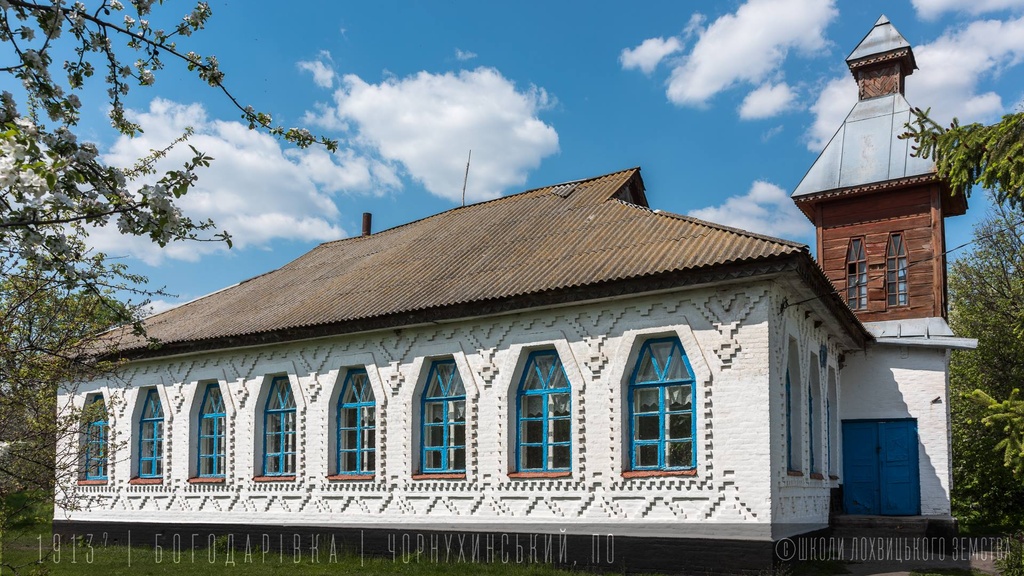
The corner sections of the schools were decorated with intricate brick arabesques reminiscent of Poltava’s «white-on-white» embroidery, while lace-like friezes ran beneath the cornices. No ornamental pattern was ever repeated — each building was unique.
Single- and double-class schools were built with one tower, while triple-class schools had two. Rising two or three tiers, the towers served both practical and decorative purposes. They marked the ceremonial entrance, from which the interior flowed naturally into the corridor, classrooms, and teachers’ room. Architecturally, the towers also broke the line of the first-floor cornice and featured the coat of arms of the Lokhvytsia district set within a hexagonal frame.
A single-class school still resembled a house divided in two, while two-class schools followed L- or T-shaped layouts. Three-class schools were arranged in T- or U-shaped plans, and four-class schools were fully U-shaped.
All of this gave the buildings a distinctive expressiveness, setting them apart from other structures in the village. The school became a center not only of education but of spiritual life, taking on a role previously held by the church. The school buildings of the Lokhvytsia district marked a new chapter in Ukrainian architecture. Before World War I, similar schools began to appear in the Kaniv district of Kyiv, the Kherson region, and the Kuban, quickly becoming a benchmark for design.
The number of schools built according to Opanas Slastion’s design remains unknown. Scholars estimate that the total number was either 93 or 98, and some may still remain undiscovered.
Oblivion
During the Soviet era, Slastion’s schools were largely neglected. From the 1930s onward, officials actively sought out signs of «bourgeois nationalism,» and schools built in the traditional style became targets, seen as symbols of Ukrainian identity. A wave of destruction followed: towers were dismantled for their so-called «Gothic character,» which officials claimed did not fit their vision of «Slavic architecture». Many of the buildings were further damaged or destroyed during the Second World War.
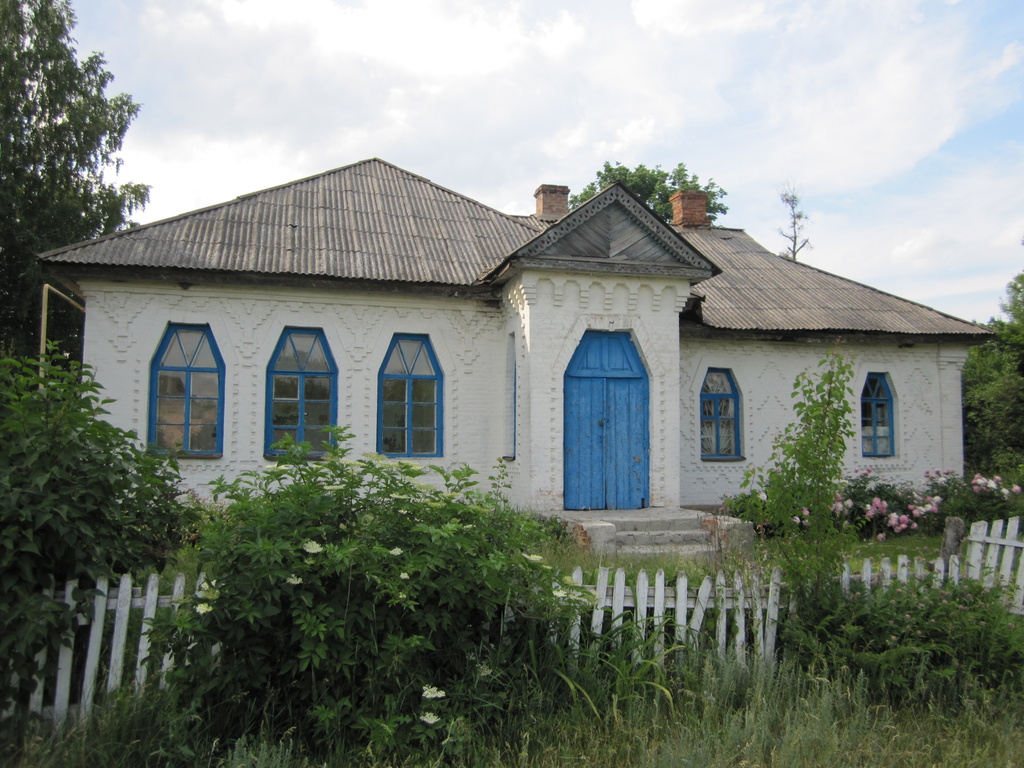
In the post-war years, the dismantling of towers continued. Roofs originally made of fiberboard panels, sheet metal, or glazed tiles were replaced with uniform slate. As the buildings were repurposed, windows were bricked up, interiors reconfigured, traditional stove-heating systems removed, and various extensions added.
It was not until the 1970s that sporadic references to folk architecture began appearing in the press, often without crediting the author. One of the first to study Slastion’s architectural legacy was Kyiv architectural historian Viktor Chepelyk, who identified six defining characteristics of folk architecture:
- a hexagonal and trapezoidal door and window openings;
- distinctive roof bends;
- tented, prismatic, and pyramidal roof forms;
- exterior galleries and overhanging eaves;
- columns with a twisted shape similar to a spiral.
These features laid the foundation for a theory of regional folk-style architecture. Today, the foremost scholar of Opanas Slastion’s legacy is art historian Vitaliy Mykolayovych Khanko.
Slastion Schools. Our Time
The schools built by the Lokhvytsia Zemstvo — in what are now the Lubenskyi and Myrhorod districts of Poltava region, the Varva district of Chernihiv region, and the Romny district of Sumy region — still hold value for local communities today. Yet most have not survived: some vanished along with the villages they once served. Currently, 57 of these schools have been identified, with 46 located in the Lubenska, Lokhvytska, Pyriatinska, and Chornukhinska communities.
In the years following Ukraine’s independence, many of the buildings fell into disrepair, and some still remain in poor condition today. A number continue to serve their original purpose, while others have been adapted for new uses, such as first-aid and midwifery stations, shops, churches, veterinary pharmacies, or private homes. This adaptation has helped protect them from complete destruction, though some have undergone alterations that have compromised their original appearance.
The surviving buildings are in urgent need of repair and restoration. They are now recognized as architectural monuments of local significance and have been added to the State Register. State protection extends to the Zemstvo school buildings in Chornukhy and in the villages of Berbenytsi (2), Bezsaly (2), Bilohorilka, Bodakva, Hayivshchyna, Zhabky, Luka, Mlyny, Nove, Pisky, Pisochky, Ryhy, Rudka, Staryi Khutir, Khrystanivka, Shevchenkove, Yablunivka, Okip, Khytsti, Bilotserkivtsi (2), Bohodarivka, Bondari, Hiltsi, Kizlivka, Kurinka, Mokiyivka, Netrativka, Piznyky, Pisky-Udaiski, Syniakivshchyna, and Kharsiky.
A Second Life or Decline
Although these buildings are officially protected cultural heritage sites, it is the initiative of local communities that truly keeps them from falling into ruin. In Bodakva, for example, the old school closed in 2007, but local teachers transformed it into a village museum, giving the building a new life.
A village museum had existed in Bodakva since the 1990s, but its exhibits were scattered across multiple buildings. The old school, meanwhile, no longer welcomed children, though its utilities were still working. It was decided to relocate the museum into the school building. As community resident Natalia Mischenko—one of the activists caring for the historic site—recalls, this gave the museum a permanent home.
«We reorganized the school together with the teachers and founded the civic organization Bodakva: Revival. To be honest, it survives entirely on our enthusiasm. When, in 2017, TV host and journalist Olha Herasymiuk began speaking about preserving these schools, we reached out to her. That was when we were able to install a commemorative plaque on the building.»
It is worth noting that thanks to Olha Herasymiuk, Slastion’s schools were granted official status as architectural landmarks of local significance, which protects them from total destruction.
Natalia Mischenko takes pride in the fact that the Bodakva school has been preserved in its original form. She explained that the Zavod City Council assisted with exterior repairs, while the activists handled all interior renovations themselves. We also discussed the need for security—the museum has been robbed twice—and the challenge that these schools are often in remote villages. Mischenko suggested that attracting visitors could combine architectural tourism with recreation along the river, making the sites more accessible and appealing.
I thank her for the conversation and for her commitment, and she responds: «How could it be any other way? We worked there; I, for instance, spent 30 years working there and was a student at that school myself. My children studied there as well.»
The notion that it is ultimately people’s commitment that can save these schools was reinforced in our conversation with Olena Romanenko, co-author and coordinator of the Ukraine Open project. In 2025, as part of Ukraine Open, she traveled across the Poltava region on research expeditions to photograph and digitize Opanas Slastion’s schools.
«Our task was to document the condition of the schools, put them on the map, and preserve them visually, so that at least some record would remain if, God forbid, any of the buildings were completely destroyed.»
Olena Romanenko noted that many of the schools were in a state of neglect: overgrown with brush, doors left open, walls full of holes, and the buildings themselves abandoned.
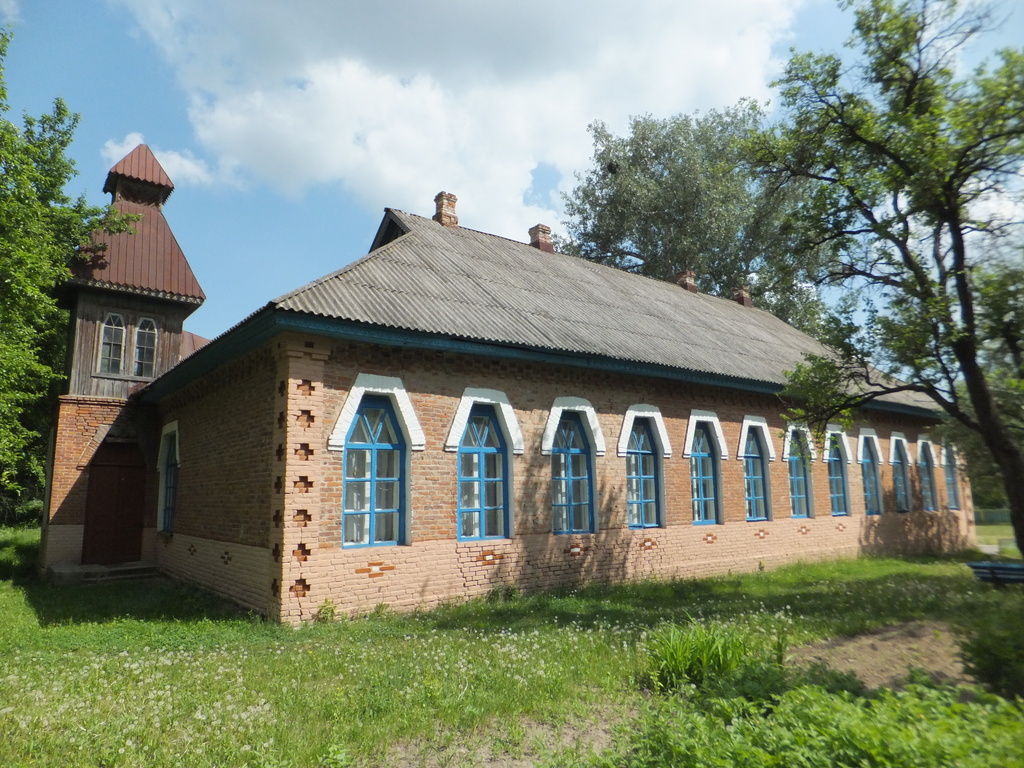
«As a rule, our trip looked like this: we would arrive in a village and try to find someone to ask where the school was, because we still had to locate it. Some residents did not understand what we were asking about until they heard the words ‘old school.’ Later we learned to find the buildings ourselves. We now know that they were supposed to stand on a high hill or at the highest point in the village.»
Olena Romanenko also explained that some of the buildings now house first-aid stations, shops, libraries, or community clubs where children’s groups meet. Others are currently not in use but are still cared for by the community.
«There’s a wonderful story about a local patron who funded the restoration of a school in a tiny village of fewer than a hundred residents. The villagers undertook the restoration themselves. At first, one side of the building served as a first-aid station, while the other was falling into ruin. After the renovation, the second part was transformed into a community club, where hobby groups meet, locals gather with musicians, and wave camouflage nets.»
One school has even been repurposed as a restaurant, managed by a local agricultural entrepreneur who replaced the windows while preserving the building’s original appearance. Yet, as Romanenko notes, some schools remain in truly dire condition — some surrounded by cemeteries, others by soybean fields.
Olena emphasizes that local communities must take primary responsibility for preserving the schools, as they are the ones who can monitor what happens around the buildings and keep track of their condition.
The buildings photographed by Olena Romanenko and her colleagues can be viewed on the Ukraine Open platform in the «Treasures of the Poltava Region» section.
Guided Tours
Though the schools are tucked away in remote villages, often requiring effort to reach and offering little else for visitors, Natalia Skoryk from Poltava has been leading tour groups to these remarkable architectural landmarks since 2019.
«We offer several routes that include visits to the Lokhvytsia Zemstvo schools. On different routes, there are schools in the villages of Yablunivka, Bezsaly, Zhabky, Tokari, Bodakva, Pisky, Zavodske/Brysy, Chornukhy, Hiltsi, Kharsiky, Kurinka, Mokiyivka, Kharkivtsi, Pisky-Udaiski, Kizlivka, Mlyny, and Pisochky.»
Natalia recalls that the first tour featuring the Lokhvytsia Zemstvo schools took place in May 2019.
«I’ve seen schools in what I would call ‘in development,’» Skoryk said. "Next to the school in Pisky, with its unique ornamentation, stands a village cemetery. In 2019 it was a short distance away, but by 2025 it had expanded right up to the school grounds. It is symbolic: the grave of a defender who died for Ukraine sits beside a Ukrainian-style school slowly deteriorating from neglect, because the building is in critical condition.
"One of the most beautiful is the school in Yablunivka. When we first arrived, we even found student wall newspapers and notebooks still inside — it was the very first year of abandonment. The school in Brysy was a pleasant surprise. In 2019, it was overgrown with weeds, and a sign noted that it had last housed a library. By 2025, the thickets had been cleared and flowers planted.
«The school in Bodakva offers another example of how a school space can be revitalized. To save it, local teachers founded a civic organization and rallied residents around important and engaging projects.»
I ask Natalia why Slastion’s schools are a heritage worth preserving and why they matter today.
«The significance of the Lokhvytsia Zemstvo schools lies in the uniqueness of the project itself. First, they represent the tension between the imperial and the traditional, the destroyed and the forgotten. Second, they showcase an innovative architectural approach: traditional forms and familiar ornamental motifs combined to create a visual language that invites reflection. Third, they embody aesthetics in the choice of location and the careful organization of space. The architect considered everyone involved in the life of the school, including the wider village community.»
Finally, I ask what an ordinary person can do to help save these schools.
«Awareness of their uniqueness alone will not save them. In my opinion, it is not one person but an entire community that can do something. We need to save what can be saved and give it new life. But the community will only save it if it understands its value. It must be a process of education and practical rethinking of their future use. It is a long-distance race, and sadly, not everyone will make it to the finish line.»
For a deeper exploration of the topic, we recommend (in Ukrainian):
Школи Сластіона: загублене минуле. Документальний проєкт Суспільного про школи Лохвицького земства
Врятувати школи Сластіона — Експедиція Ukraïner
Опанас Сластьон / Віталій Ханко. — Харків: Видавець Олександр Савчук, 2022. — 298 с., 54 іл.
 Український тиждень


